
Palmchat Dulus dominicus Scientific name definitions
- LC Least Concern
- Names (28)
- Monotypic
Revision Notes
Sign in to see your badges
Species names in eBird-supported languages
| Language | Common name |
|---|---|
| Bulgarian | Палмова копринарка |
| Catalan | cigua de les palmeres |
| Chinese (SIM) | 棕榈䳭 |
| Croatian | palmašica |
| Czech | brkoslavec palmový |
| Danish | Palmedrossel |
| Dutch | Palmtapuit |
| English | Palmchat |
| English (AVI) | Palmchat |
| English (United States) | Palmchat |
| Estonian | palmilind |
| Finnish | palmulainen |
| French | Esclave palmiste |
| German | Palmenschwätzer |
| Haitian Creole (Haiti) | Zwazo-palmis |
| Japanese | ヤシドリ |
| Latvian | Palmčivulis |
| Norwegian | palmetrost |
| Polish | palmowiec |
| Russian | Дулюс |
| Serbian | Palmarka |
| Slovak | dulus družný |
| Spanish | Sigua palmera |
| Spanish (Dominican Republic) | Cigua Palmera |
| Spanish (Spain) | Sigua palmera |
| Swedish | palmtrast |
| Turkish | Dominik Palmiyekuşu |
| Ukrainian | Пальмовик |
Revision Notes
Spencer Schubert, Holly Garrod, and André Dhondt as part of a partnership with BirdsCaribbean. Arnau Bonan Barfull curated the media. Qwahn Kent copyedited the account.
Dulus dominicus (Linnaeus, 1766)
Definitions
- DULUS
- dominicensis / dominicus
- Dominicus
The Key to Scientific Names
Legend Overview
Content Partner

Full content is available exclusively to Birds of the World subscribers. Sign in Learn more
Introduction
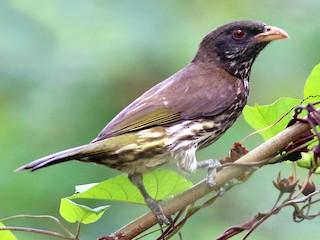
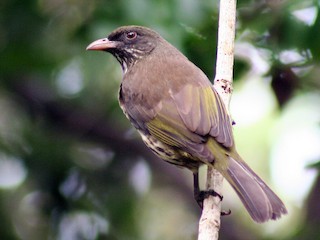
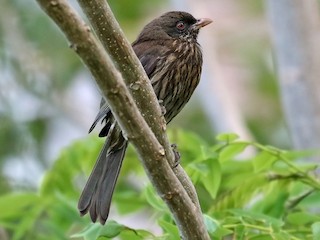
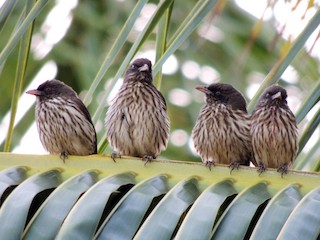
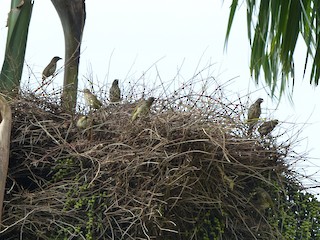
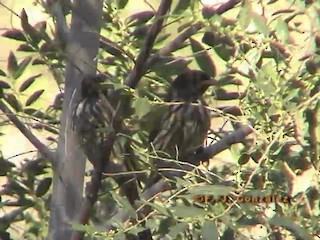
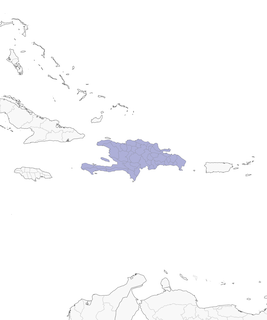
The sole member of the genus Dulus and the family Dulidae, the Palmchat is confined to Hispaniola, where it is one of the island's most abundant and conspicuous residents. Palmchat is easily identified by its pale-yellow bill, heavily dark-streaked underparts, olive brown upperparts, and red irides. It is common in urban areas, but perhaps reach its maximum densities in savannas dominated by royal palms; it is absent from densely forested regions and the island's highest elevations. A communal breeder, it builds huge 'apartment block' compound nests that are routinely used by up to ten pairs, and which in rare cases may be occupied by many as 50 individuals. It is primarily frugivorous, although it occasionally feeds on nectar and arthropods.
- Year-round
- Migration
- Breeding
- Non-Breeding